
Crying Girl
1899
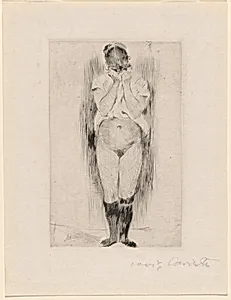
Medium
etching in black on wove paper
Dimensions
plate: 13.97 × 8.89 cm (5 1/2 × 3 1/2 in.) sheet: 19.69 × 15.24 cm (7 3/4 × 6 in.)
Classification
Department
CG-W
Museum
National Gallery of Art, Washington, D.C.
Credit
Gift of Christopher and Beverly With in memory of Karl and Gerda With
Accession Number
2019.156.7
Rights
Public Domain
Art Historical Context
**Crying Girl** (1899) is a poignant etching by Lovis Corinth, one of Germany's most dynamic artists of the late 19 and early 20th. Created during Corinth's Berlin period, when he was embracing a more personal and expressive style influenced by Impressionism and emerging Expressionism, this intimate print measures just 13.97 × 8.89 cm on the plate. The modest scale draws viewers close, inviting empathy with the subject's raw emotion. Etching in black ink on smooth wove paper exemplifies Corinth's mastery of printmaking techniques. He incised his design into a metal plate with acid, creating fine, fluid lines that convey depth and texture through tonal contrasts. This medium allowed artists like Corinth—also renowned for his bold paintings—to produce detailed, editioned works that democratized art, reaching beyond elite collectors. Corinth's etchings often explored human vulnerability, reflecting fin-de-siècle interests in psychology and inner turmoil. Generously gifted to the National Gallery of Art by Christopher and Beverly With in memory of Karl and Gerda With, **Crying Girl** highlights Corinth's versatility and emotional intensity. A gem in the Prints department, it captures the artist's innovative bridge between traditional techniques and modern sensibilities, offering visitors a window into the human heart at the turn of the century.
About the Artist
Lovis Corinth · 1858–1925
Lovis Corinth, born Franz Heinrich Louis on July 21, 1858, in Tapiau, East Prussia (now Gvardeysk, Russia), to a tanner father, displayed prodigious drawing talent from childhood. He began formal training at the Königsberg Academy in 1876, then moved to the Academy of Fine Arts in Munich from 1880 to 1884, studying under Ludwig von Löfftz and briefly Franz von Defregger, where he absorbed a Realis...