
César
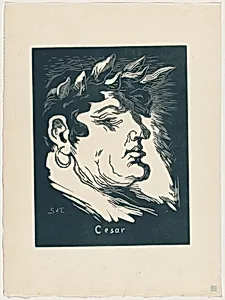
Medium
woodcut in green on thin japan paper
Classification
Department
CG-E
Museum
National Gallery of Art, Washington, D.C.
Credit
Virginia and Ira Jackson Collection, gift in memory of Virginia H. Jackson
Accession Number
1996.151.203
Rights
Public Domain
Art Historical Context
Georges d'Espagnat's *César* (1895) is a striking woodcut printed in green ink on delicate thin Japan paper exemplifying the French artist's early mastery of printmaking. Born in 1870, d'Espagnat was a post-Impressionist painter andaver whose works bridged the luminous brushwork of the Impressionists with bolder color explorations that foreshadowed Fauvism. This intimate print, likely a portrait, captures the era's fascination with expressive monochrome tones, using the woodcut's bold, carved lines to convey form and emotion with economy and power. Woodcuts, a technique revived in late 19th-century France amid influences from Japanese ukiyo-e prints, demanded precise carving into wood blocks—a labor-intensive process that allowed for rich textures and subtle tonal variations. The choice of thin Japan paper, prized for its absorbency and translucency, enhances the ink's vibrancy and the print's luminous quality, making it a collector's gem from the fin-de-siècle print renaissance alongside artists like Gauguin and Munch. Housed in the National Gallery of Art's Department of Modern Prints (CG-E), *César* entered the collection through the generous gift of Virginia and Ira Jackson in memory of Virginia H. Jackson. It invites visitors to appreciate how d'Espagnat's innovative techniques distilled personality into simple, evocative lines, bridging everyday portraiture with artistic innovation.