
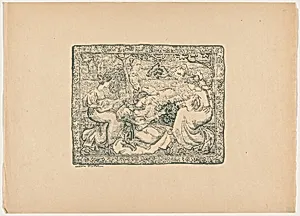
Tapisserie (Tapestry)
1895
Medium
lithograph in green on thin japan paper
Classification
Department
CG-E
Museum
National Gallery of Art, Washington, D.C.
Credit
Virginia and Ira Jackson Collection, gift in memory of Virginia H. Jackson
Accession Number
1996.151.121
Rights
Public Domain
Art Historical Context
**Tapisserie (Tapestry, created by Aristide Maill in 1895, is a striking lithograph printed in green ink on delicate thin Japan paper. Maillol, a renowned artist best known for his voluptuous bronze sculptures of the female form, began his career in painting and printmaking before fully embracing sculpture. This work captures his early experimentation with decorative motifs, reflecting the Symbolist and Nabi influences of the fin-de-siècle period, where artists blurred lines between fine art and craft. Printed as a single-color lithograph, *Tapisserie* showcases Maillol's mastery of the medium, which allowed for fluid lines and subtle tonal gradations ideal for evoking textile textures. Japan paper, prized for its silky smoothness and absorbency, enhances the print's luminous quality, making it a collector's gem. Likely a design study for woven tapestries—a medium Maillol explored amid the Arts and Crafts revival— it embodies the era's fascination with integrating art into everyday luxury. Housed in the National Gallery of Art's CG-E department as part of the Virginia and Ira Jackson Collection, this print highlights Maillol's versatility and the Jackson family's legacy in supporting exceptional works on paper. Visitors will appreciate its elegant simplicity, a window into an artist's evolving vision.
About the Artist
Aristide Maillol · 1861–1944
Aristide Maillol (1861–1944) was a French sculptor, painter, and printmaker born in the coastal village of Banyuls-sur-Mer in Roussillon. From a young age, he aspired to be an artist, moving to Paris in 1881 despite living in poverty. He studied at the École des Arts Décoratifs in 1883 and was accepted into the prestigious École des Beaux-Arts in 1885, where he trained under the academic masters J...