
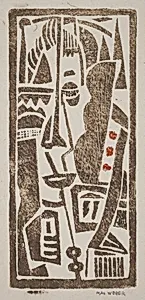
Cubist Head
1919-1920
Medium
color woodcut on wove paper
Dimensions
image: 10.7 × 4.8 cm (4 3/16 × 1 7/8 in.) sheet: 25.8 × 16.5 cm (10 3/16 × 6 1/2 in.)
Classification
Department
CG-W
Museum
National Gallery of Art, Washington, D.C.
Credit
Reba and Dave Williams Collection, Gift of Reba and Dave Williams
Accession Number
2008.115.4981
Rights
Public Domain
Art Historical Context
### Cubist Head by Max Weber Step into the fragmented world of early 20th-century modernism with *Cubist Head* (1919-1920), a striking color woodcut by Max, a Russian-born American artist pivotal in introducing Cubism to the United States. Created just after World War I, intimate print captures the essence of Cubism's revolutionary approach: breaking down the human form into geometric planes, interlocking shapes, and multiple viewpoints simultaneously. Weber, influenced by pioneers like Picasso and Braque, adapted this style to explore abstraction while retaining emotional depth. Printed on wove paper, the work's diminutive image (just 10.7 × 4.8 cm) invites close inspection, revealing the technical mastery of color woodcutting—a labor-intensive relief process using multiple blocks inked in vibrant hues to layer tones and textures. This medium bridged traditional printmaking with avant-garde experimentation, making modernist ideas accessible beyond oil paintings. Housed in the National Gallery of Art's Reba and Dave Williams Collection, *Cubist Head* exemplifies Weber's versatility across painting and prints, offering visitors a window into America's embrace of European modernism. (178 words)
About the Artist
Max Weber · 1881–1961
Max Weber (1881–1961), born in Białystok in the Russian Empire (now Poland) to Orthodox Jewish parents, immigrated to Brooklyn, New York, at age ten with his family, joining his tailor father.) There, he pursued art studies at the Pratt Institute under Arthur Wesley Dow, an innovative teacher who emphasized expression and form over traditional narrative, drawing from Japanese art and Paul Gauguin....