
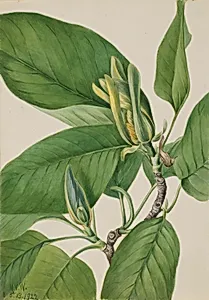
Cucumbertree (Magnolia acuminata)
Medium
Painting
Classification
Painting
Department
Smithsonian Collection
Museum
Smithsonian American Art Museum
Credit
Smithsonian American Art Museum, Gift of the artist
Accession Number
1970.355.569
Rights
Public Domain
Tags
Art Historical Context
Mary Vaux Walcott's *Cucumbertree (Magnolia acuminata)*, painted in 1922, captures the delicate beauty of this native North American tree, known for its cucumber-shaped cones and vibrant yellow-green flowers. As part of the Smithsonian American Art Museum's collection—gifted directly by the artist—this painting exemplifies Walcott's lifelong passion for botanical illustration. A talented Quaker artist, naturalist, and mountaineer (1860–1940), she created hundreds of precise watercolor paintings during summer expeditions in the Canadian Rockies and American wilderness, blending scientific accuracy with artistic grace. Walcott's style reflects the early 20th-century tradition of botanical art, where paintings served both aesthetic and educational purposes, aiding botanists in species identification. Her works, often in watercolor on paper, highlight the Magnolia acuminata's distinctive leaves and blooms with meticulous detail, showcasing her skill in rendering translucent petals and textured bark. This piece contributed to her renowned series *North American Wild Flowers*, published in 1925 under Smithsonian auspices, underscoring the era's growing appreciation for America's native flora amid expanding scientific exploration. Today, *Cucumbertree* invites visitors to marvel at nature's intricacies through Walcott's lens, a testament to women pioneers in art and science who documented the continent's biodiversity before widespread habitat loss. A gentle reminder of conservation's roots in observation and wonder.