
Cuirassier Armor
Unknown Artist
ca. 1610–30
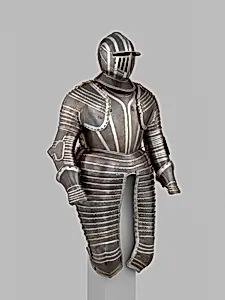
Medium
Steel, gold, leather, textile
Dimensions
H. as mounted 54 in. (137.2 cm); Wt. 86 lb. 8 oz. (39.24 kg)
Classification
Armor for Man
Culture
Italian, Milan or Brescia
Department
Arms and Armor
Museum
Metropolitan Museum of Art, New York, NY
Credit
Purchase, Arthur Ochs Sulzberger Gift, 2002
Accession Number
2002.130a–p
Rights
Public Domain
Art Historical Context
Step into the clangor of 17th-century battlefields with this magnificent *Cuirassier Armor*, crafted around 1610–30 in Milan or Brescia, Italy—renowned hubs of Renaissance armor-making. Designed for a cuirassier, the elite heavy cavalryman who charged with pistol and sword, this full suit protected its wearer from head to toe while allowing mobility for thunderous assaults. Now on view at The Metropolitan Museum of Art, thanks to the Arthur Ochs Sulzberger Gift of 2002, it stands as a testament to Italian mastery in the Arms and Armor collection. Forged from steel, the armor gleams with gold accents, leather straps, and textile linings, blending brute functionality with opulent decoration. Artisans likely employed repoussé techniques to shape the metal into form-fitting plates, etched or gilded for both protection and prestige. At 54 inches tall when mounted and weighing a hefty 86 pounds, it evokes the physical demands on soldiers—imagine donning this for the chaos of Europe's Thirty Years' War era, when plate armor still countered blades amid rising firearms. This piece highlights the twilight of chivalric warfare, where beauty met lethality. Its survival offers a tactile link to a world of armored knights, reminding us how craftsmanship turned war into wearable art.