
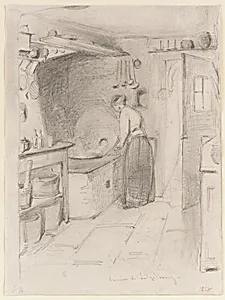
Cuisine a Lutzelbourg
Classification
Drawing
Department
Smithsonian Collection
Museum
Smithsonian American Art Museum
Credit
Gift of Charles Lang Freer
Accession Number
F1898.151
Rights
Public Domain
Tags
About this artwork
Seymour Haden (1818-1910), London [1]
Art Historical Context
James McNeill Whistler’s *Cuisine à Lutzelbourg* (1858) captures a intimate glimpse into everyday life, likely depicting a woman preparing a meal in a modest kitchen in the Alsatian village of Lutzelbourg France. Created early in Whistler’s career, this drawing reflects his budding interest in realist scenes of ordinary people and places, influenced by his travels through Europe. Though best known later for his ethereal nocturnes and the mantra “art for art’s sake,” Whistler here demonstrates a keen eye for domestic tranquility, rendered with the precise lines characteristic of his draftsmanship. The work’s provenance adds rich layers: it once belonged to Seymour Haden, a prominent London etcher and Whistler’s relative by marriage, who accompanied the artist on sketching trips to the Rhineland and Alsace in 1858. Haden’s collection highlights Whistler’s early etching experiments, bridging British and French artistic circles. Gifted to the Smithsonian American Art Museum by industrialist Charles Lang Freer—one of Whistler’s greatest patrons—this piece joins a treasury of American expatriate art, underscoring Whistler’s enduring ties to his U.S. roots despite his cosmopolitan life. As a drawing from Whistler’s formative years, *Cuisine à Lutzelbourg* offers a window into the artist’s evolution, blending observation with subtle harmony—foreshadowing his tonal mastery. Visitors will appreciate its quiet charm amid the museum’s Freer collection gems.