
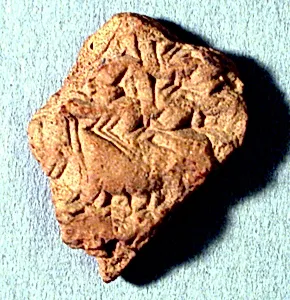
Cuneiform tablet: fragment of a liver omen
Unknown Artist
ca. late 1st millennium BCE
Medium
Clay
Dimensions
1 x 7/8 x 3/8 in. (2.6 x 2.1 x 0.8 cm)
Classification
Clay-Tablets-Inscribed
Department
Ancient Near Eastern Art
Museum
Metropolitan Museum of Art, New York, NY
Credit
Purchase, 1886
Accession Number
86.11.549
Rights
Public Domain
Art Historical Context
This tiny clay tablet fragment, dating to around the late 1st BCE, offers a fascinating glimpse into the ancient Near East's world of divination. Inscribed with cuneiform—the wedge-shaped script pressed into soft clay with a reed stylus—it records part of a "liver," a practice known as extispicy. Ancient Mesopotamians, Babylonians, and Assyrians sheep livers for signs from the gods, interpreting shapes, markings, and textures to predict like victory in battle or royal fortunes. These omens guided kings and priests in critical decisions, blending religion, science, and statecraft. Crafted from humble clay, the tablet's survival highlights the durability of this medium, fired or sun-dried to last millennia. At just 1 x 7/8 x 3/8 inches, it was likely part of a larger series or manual, showcasing the meticulous precision of cuneiform scribes. Acquired by the Metropolitan Museum of Art in 1886, this artifact from the Ancient Near Eastern collection underscores how everyday objects preserved profound cultural beliefs, revealing a society where the divine spoke through animal entrails. (178 words)