
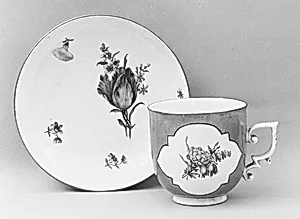
Cup
ca. 1740
Medium
Hard-paste porcelain
Dimensions
Height: 2 3/4 in. (7 cm); Diameter: 1 7/8 in. (4.8 cm)
Classification
Ceramics-Porcelain
Culture
German, Meissen
Department
European Sculpture and Decorative Arts
Museum
Metropolitan Museum of Art, New York, NY
Credit
Gift of Alfred Duane Pell, 1902
Accession Number
02.6.243
Rights
Public Domain
Tags
Art Historical Context
This delicate cup from the Meissen Manufactory, crafted around 1740, exemplifies the pinnacle of early European porcelain production. Standing just 2¾ inches tall with a diameter of 1⅞ inches, it was designed for intimate use—perhaps as a chocolate or coffee cup in fashionable Rococo salons. Made of hard-paste porcelain, a breakthrough material developed by Meissen in 1710, it offered the translucency and durability of prized Chinese imports, but produced locally in Saxony, Germany. Meissen's innovation ended Europe's dependence on Asian porcelain, sparking a decorative arts revolution. By the 1740s, under artists like Johann Joachim Kändler, the manufactory perfected techniques such as underglaze painting and gilding, often adorning pieces with vibrant floral motifs symbolizing abundance and nature's beauty. The intricate flower designs on this cup reflect the era's ornate aesthetic, blending technical mastery with playful elegance. A gift to the Metropolitan Museum of Art in 1902, this tiny treasure invites us to appreciate the fusion of artistry and alchemy that made Meissen synonymous with luxury. Handle with care—its fragility mirrors the fleeting pleasures of 18th-century high society!
About the Artist
Meissen Manufactory · 1710–present
The Meissen Manufactory, established on June 6, 1710, by Augustus the Strong, Elector of Saxony and King of Poland, marked the dawn of true hard-paste porcelain production in Europe. Nestled at Albrechtsburg Castle in Meissen near Dresden, the Royal Polish and Electoral Saxon Porcelain Manufactory arose from alchemical experiments begun in 1708 by physicist Ehrenfried Walther von Tschirnhaus and p...