
Cup
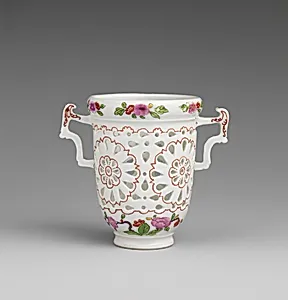
Medium
Hard-paste porcelain
Dimensions
3 × 3 7/8 in. (7.6 × 9.8 cm)
Classification
Ceramics-Porcelain
Culture
Austrian, Vienna
Department
European Sculpture and Decorative Arts
Museum
Metropolitan Museum of Art, New York, NY
Credit
The Hans Syz Collection, Gift of Stephan B. Syz and John D. Syz, 1995
Accession Number
1995.268.284
Rights
Public Domain
Tags
Art Historical Context
This delicate cup, crafted during the Claudius Innocentius du Paquier period in Vienna around 1730–35, exemplifies the early triumphs of Austrian hard-paste porcelain. at du Paquier's pioneering manufactory—the first in Vienna to master this demanding medium—the cup measures a dainty 3 × 3 7/8 inches, perfect for intimate sips of coffee or chocolate, beverages then sweeping European high society. Hard-paste, fired at intense temperatures from kaolin clay, yielded a translucent, durable body rivaling prized Chinese imports and Meissen wares from nearby Saxony. Viennese potters like those at du Paquier innovated with vibrant overglaze enamels, often adorning pieces with lush floral motifs—evident here in the tagged flower designs—that blended Eastern influences with emerging Rococo exuberance. These cups were status symbols for the aristocracy, showcasing technical prowess amid the Habsburg Empire's cultural flourishing. Today, this gem from The Hans Syz Collection at The Metropolitan Museum of Art invites us to appreciate the artistry of 18th-century innovation, where science met splendor in everyday elegance.