
Cup
Unknown Artist
10th–11th century
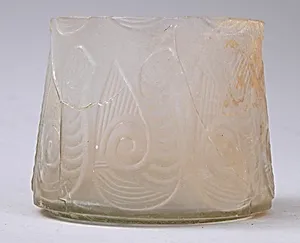
Medium
Glass; free blown, tooled, and relief cut
Dimensions
H. 2 3/8 in. (6.0 cm) Diam. of base: 3 in. (7.6 cm) Diam. of rim: 2 3/4 in. (7.0 cm)
Classification
Glass
Department
Islamic Art
Museum
Metropolitan Museum of Art, New York, NY
Credit
Purchase, Rogers Fund and Margaret Mushekian Gift, 1975
Accession Number
1975.442
Rights
Public Domain
Tags
Art Historical Context
This delicate glass cup, crafted by an unknown artist in the th–11th century, exemplifies the refined artistry of Islamic glassmaking a golden age of technical innovation. Housed in the Metropolitan Museum of Art's Islamic Department, it measures just 2⅜ inches tall with a sturdy 3-inch base and 2¾-inch rim, making it a perfect everyday vessel—perhaps for sipping aromatic herbal infusions or precious rosewater in a bustling medieval household. The cup's medium reveals masterful techniques: free-blown to form its graceful shape from molten glass, tooled for precise contours, and relief-cut to create subtle, tactile patterns. These methods, perfected in regions like Syria and Egypt under Fatimid or Abbasid patronage, highlight glass's versatility as an affordable yet luxurious alternative to metal or ceramics. Relief cutting, in particular, added depth and light-play, transforming a simple object into a shimmering jewel. Such cups were cultural staples, bridging utility and beauty in Islamic society, where craftsmanship reflected spiritual ideals of harmony and precision. Acquired in 1975 through the Rogers Fund and a generous gift, it invites us to ponder the anonymous hands that shaped everyday elegance over a millennium ago.