
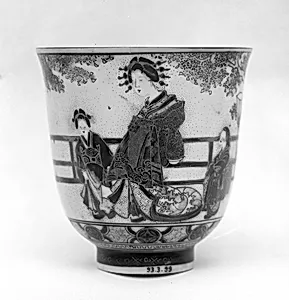
Cup
Unknown Artist
19th century
Medium
White porcelain decorated with red and gold (Hizen ware, Kutani type)
Dimensions
H. 3 1/4 in. (8.3 cm)
Classification
Ceramics
Culture & Period
Japan · Edo period (1615–1868)
Department
Asian Art
Museum
Metropolitan Museum of Art, New York, NY
Credit
Gift of Charles Stewart Smith, 1893
Accession Number
93.3.99
Rights
Public Domain
Tags
Art Historical Context
This delicate porcelain cup, crafted in Japan during the late Edo period1615–1868), the refined artistry of 19th-century Hizen, a renowned style originating from the Hizen province (modern-day Saga Prefecture). Standing just 3¼ inches (8.3 cm) tall, the cup features a pristine white body adorned with vibrant red and gold overglaze enamels in the Kutani type—a bold, colorful aesthetic typically associated with Ishikawa Prefecture's Kutani kilns but widely emulated in Hizen porcelain for export and domestic luxury. Likely depicting graceful women, as suggested by its motifs, the piece reflects the period's fascination with bijin-ga (beautiful women) imagery, celebrating feminine elegance amid Japan's cultural flourishing. Hizen ware, pioneered at Arita kilns in the 17th century, revolutionized Japanese ceramics by mastering kaolin-based porcelain, rivaling Chinese imports and fueling global trade via Nagasaki. The Kutani-style decoration, applied after firing and refired at lower temperatures, allowed for intricate, durable polychrome designs that captured the opulence of Edo urban life. Gifted to the Metropolitan Museum of Art in 1893 by Charles Stewart Smith, this cup offers a window into the shogunate era's artisanal innovation, where everyday objects like sake or tea cups became canvases for poetic beauty and technical prowess. A testament to Japan's ceramic legacy, it invites visitors to appreciate the harmony of form, color, and tradition.