
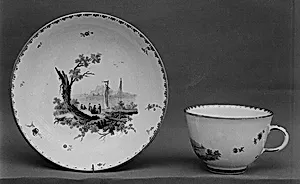
Cup and saucer
Medium
Hard-paste porcelain
Dimensions
Height (cup .214): 2 in. (5.1 cm); Diameter (saucer .215): 5 1/16 in. (12.9 cm)
Classification
Ceramics-Porcelain
Culture
German, Frankenthal
Department
European Sculpture and Decorative Arts
Museum
Metropolitan Museum of Art, New York, NY
Credit
Gift of Alfred Duane Pell, 1902
Accession Number
02.6.214, .215
Rights
Public Domain
Tags
Art Historical Context
This delicate cup and saucer, by the renowned Frankenthal Porcelain Manactory during the Karl Theodor period around 1770, exemplifies the pinnacle of 18th-century German porcelain artistry. Crafted from hard-paste porcelain—a advanced material fired at high temperatures to achieve the translucent, resonant quality rivaling Chinese imports—the set measures a dainty 2 inches tall for the cup and inches across the saucer. Gifted to the Metropolitan Museum of Art in 1902, it resides in the European Sculpture and Decorative Arts collection, showcasing Frankenthal's mastery in the Rococo style. Frankenthal, established in 1755 in the Electorate of the Palatinate under Elector Karl Theodor, quickly rose as a competitor to Meissen, famed for its intricate overglaze enameling and gilding. This manufactory specialized in tableware adorned with vivid, naturalistic scenes, often featuring flowers, trees, and pastoral motifs like boats on serene waters, evoking idyllic landscapes. The Karl Theodor period marked a flourishing of such decorative porcelain, blending technical innovation with opulent designs for aristocratic tables. For visitors, this piece whispers of Enlightenment-era luxury, where everyday objects became canvases for artistic whimsy. Its enduring appeal lies in the precise hand-painting, capturing fleeting beauty in porcelain's glassy sheen—a testament to German ceramic ingenuity.