
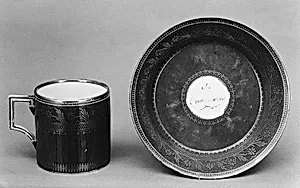
Cup and saucer
ca. 1790
Medium
Hard-paste porcelain
Dimensions
Overall (Cup [.277]): 2 1/2 × 2 1/2 in. (6.4 × 6.4 cm); Diameter (Saucer [.278]): 5 1/4 in. (13.3 cm)
Classification
Ceramics-Porcelain
Culture
German, Meissen
Department
European Sculpture and Decorative Arts
Museum
Metropolitan Museum of Art, New York, NY
Credit
Gift of Alfred Duane Pell, 1902
Accession Number
02.6.277, .278
Rights
Public Domain
Tags
Art Historical Context
This delicate cup and saucer, crafted by the renowned Meissen Manufactory 1790, exemplifies pinnacle of 18th-century European porcelain. Made from hard-paste porcelain—a translucent, durable material pioneered by Meissen in 1710 after decades of secretive experimentation—the set measures a dainty 2½ × 2½ inches for the cup and 5¼ inches in saucer diameter. Adorned with floral motifs it reflects the manufactory's mastery in blending technical innovation with elegant decoration, perfect for aristocratic tea rituals. Meissen, based in Saxony, Germany, was Europe's first producer of true porcelain, rivaling coveted Chinese imports and fueling a craze among nobility. By the late 1700s, under neoclassical influences, pieces like this featured refined painting and gilding on vitrified surfaces that withstood high firing temperatures. These luxury goods symbolized wealth and sophistication, often customized for royal tables. Today, this gift from Alfred Duane Pell in 1902 graces the Metropolitan Museum of Art's European Sculpture and Decorative Arts collection. Handling it, visitors can appreciate how Meissen elevated ceramics to fine art, bridging utility and opulence in everyday indulgence.
About the Artist
Meissen Manufactory · 1710–present
The Meissen Manufactory, established on June 6, 1710, by Augustus the Strong, Elector of Saxony and King of Poland, marked the dawn of true hard-paste porcelain production in Europe. Nestled at Albrechtsburg Castle in Meissen near Dresden, the Royal Polish and Electoral Saxon Porcelain Manufactory arose from alchemical experiments begun in 1708 by physicist Ehrenfried Walther von Tschirnhaus and p...