
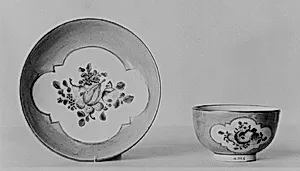
Cup and saucer
ca. 1760–65
Medium
Soft-paste porcelain
Dimensions
Height (cup .375a): 1 5/8 in. (4.1 cm); Diameter (saucer .375b): 4 1/2 in. (11.4 cm)
Classification
Ceramics-Porcelain
Culture
Italian, Nove
Department
European Sculpture and Decorative Arts
Museum
Metropolitan Museum of Art, New York, NY
Credit
Rogers Fund, 1906
Accession Number
06.375a, b
Rights
Public Domain
Tags
Art Historical Context
This delicate cup and saucer, crafted around 1760–65 by the Le Nove Porcelain Manufactory in Nove, Italy, exemplifies the refined European pursuit of porcelain during the mid-eighteenth century. Made of soft-paste porcelain—a material developed as European makers sought to replicate the luminous quality of prized Chinese hard-paste wares—the set reflects the technical experimentation and artistic ambition of Italian ceramic workshops. Its modest scale, with the cup standing just over an inch and a half tall, suggests it was designed for intimate tea service, a fashionable social ritual among the period’s elite. The manufactory at Nove, active from the 1750s onward, became celebrated for its graceful tablewares adorned with floral motifs. The flower decorations noted on this piece highlight the Rococo taste for naturalistic ornament, rendered here with the soft, luminous glazes characteristic of soft-paste porcelain. Such objects bridged utility and beauty, transforming everyday moments into occasions of elegance. Acquired by the Metropolitan Museum through the Rogers Fund in 1906, this cup and saucer offers visitors a tangible connection to Italy’s contribution to the golden age of European porcelain. Its survival speaks to the enduring appeal of these finely potted forms, where technical skill and decorative charm combined to elevate domestic life.