
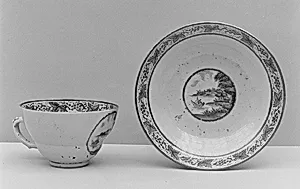
Cup and saucer
Unknown Artist
late 18th century
Medium
Hard-paste porcelain
Dimensions
Overall (cup .49): 2 1/4 × 3 5/8 in. (5.7 × 9.2 cm); Overall (saucer .50): 1 1/4 × 5 1/2 in. (3.2 × 14 cm)
Classification
Ceramics-Porcelain-Export
Culture
Chinese, possibly for British market
Department
European Sculpture and Decorative Arts
Museum
Metropolitan Museum of Art, New York, NY
Credit
Bequest of W. Gedney Beatty, 1941
Accession Number
41.160.49, .50
Rights
Public Domain
Tags
Art Historical Context
This delicate cup and saucer, crafted in hard-paste porcelain by an unknown Chinese artist in the late 18th century, exemplifies the exquisite export wares that fueled global trade during the era. Produced for the British market, these pieces were part of China's booming porcelain industry, which supplied Europe's elite with luxury goods via the East India Company. Hard-paste porcelain, fired at high temperatures for exceptional durability and translucency, represented a pinnacle of technical mastery, far surpassing European imitations at the time. Adorned with finely painted landscapes and ships, the decoration captures the maritime themes popular among Western collectors, evoking the very voyages that carried these treasures across oceans. Such motifs blended Chinese artistic traditions—delicate brushwork and serene vistas—with European tastes, making them coveted status symbols in British drawing rooms. Now housed in the Metropolitan Museum of Art's Department of European Sculpture and Decorative Arts, thanks to the 1941 bequest of W. Gedney Beatty, this set invites us to ponder the cultural exchanges of the Enlightenment age, where everyday objects bridged distant worlds.