
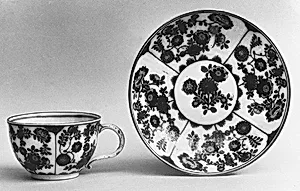
Cup and saucer
ca. 1765
Medium
Hard-paste porcelain
Dimensions
Height (cup .214): 1 7/8 in. (4.8 cm); Diameter (saucer .215): 5 1/4 in. (13.3 cm)
Classification
Ceramics-Porcelain
Culture
German, Meissen
Department
European Sculpture and Decorative Arts
Museum
Metropolitan Museum of Art, New York, NY
Credit
The George B. McClellan Collection, Gift of Mrs. George B. McClellan, 1941
Accession Number
42.205.214, .215
Rights
Public Domain
Tags
Art Historical Context
This elegant cup and saucer, by the renowned Meissen Manufactory around 1765, exemplifies the pinnacle of 18th-century European porcelain. Produced in hard-paste porcelain—a durable, translucent material that Meissen perfected as the first in Europe in 1710—this delicate set measures a dainty 1 7/8 inches tall for the cup and 1/4 inches across the saucer. The German manufactory, based in Saxony, revolutionized luxury goods by replicating the prized Chinese porcelain that had captivated European courts for centuries. Adorned with floral motifs, a hallmark of Meissen's Rococo style, the pieces showcase meticulous hand-painting and gilding techniques. Artisans applied vibrant overglaze enamels and molded delicate "pulled" flowers, creating a playful abundance that reflected the era's opulent tastes among nobility and the emerging bourgeoisie. These tableware items were status symbols, blending functionality with exquisite decoration for tea rituals that symbolized refinement. Today, housed in the Metropolitan Museum of Art's European Sculpture and Decorative Arts department as part of The George B. McClellan Collection (gifted in 1941), this cup and saucer invites us to appreciate Meissen's enduring legacy in ceramics, bridging technical innovation with timeless beauty.
About the Artist
Meissen Manufactory · 1710–present
The Meissen Manufactory, established on June 6, 1710, by Augustus the Strong, Elector of Saxony and King of Poland, marked the dawn of true hard-paste porcelain production in Europe. Nestled at Albrechtsburg Castle in Meissen near Dresden, the Royal Polish and Electoral Saxon Porcelain Manufactory arose from alchemical experiments begun in 1708 by physicist Ehrenfried Walther von Tschirnhaus and p...