
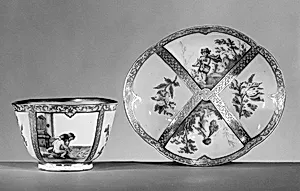
Cup and saucer
Medium
Hard-paste porcelain
Dimensions
Overall (cup .1): 2 × 3 1/8 in. (5.1 × 7.9 cm); Diameter (saucer .2): 4 5/16 in. (11 cm)
Classification
Ceramics-Porcelain
Culture
Italian, Florence
Department
European Sculpture and Decorative Arts
Museum
Metropolitan Museum of Art, New York, NY
Credit
The Charles E. Sampson Memorial Fund, 1971
Accession Number
1971.191.1, .2
Rights
Public Domain
Tags
Art Historical Context
This elegant hard-paste porcelain cup and saucer, created around 1750–55 at the Doccia Porcelain Manufactory in Florence, exemplifies the early achievements of Italian porcelain production. Founded in 1735 by Marche Carlo Ginori, Doccia was among the first European factories to master the challenging technique of hard-paste porcelain, previously known primarily through imports from China and Meissen. The refined, translucent body and delicate proportions of this set highlight the technical skill achieved within two decades of the factory’s founding. The decoration, drawn from designs by the French artist Jacques Stella and engraved by his niece Claudine Bouzonnet Stella, features playful putti with musical instruments. These motifs, popular in 17th-century French art, were adapted here to suit the curved surfaces of the cup and saucer. Such pieces were intended for display as much as use, reflecting the 18th-century taste for refined tableware that blended sculpture, painting, and luxury materials. Today in the Metropolitan Museum of Art’s collection, this cup and saucer offers visitors a glimpse into the international exchange of artistic ideas that shaped European porcelain during the Enlightenment.
About the Artist
Doccia Porcelain Manufactory|Marchese Carlo Ginori|Jacques Stella|Claudine Bouzonnet Stella · 1737–1896
The Doccia Porcelain Manufactory, founded in 1737 by Marquis Carlo Ginori near Florence, holds the distinction of being Italy's first hard-paste porcelain manufacturer and one of the few European porcelain enterprises to survive from the eighteenth century to the present day without interruption. Unlike most contemporary ventures — which depended on the patronage and protection of ruling courts — ...