
Cup and Saucer
1750–75
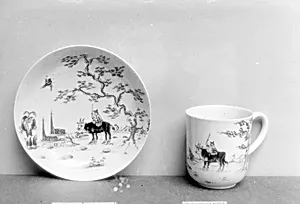
Medium
Porcelain (soft-paste)
Dimensions
Cup: 2 5/8 x 2 1/4 in. (6.7 x 5.7 cm) Saucer: Diam. 4 3/4 in. (12.1 cm)
Classification
Cup and saucer
Culture
British
Department
The American Wing
Museum
Metropolitan Museum of Art, New York, NY
Credit
Rogers Fund, 1927
Accession Number
27.17.29, .30
Rights
Public Domain
Tags
Art Historical Context
This delicate cup and saucer, produced by the Worcester Porcelain Factory between 1750 and 1775, exemplifies the golden age of English soft-paste porcelain. Founded around 1751 in Worcestershire, England, the factory quickly rose to prominence as a rival to Chinese imports, mastering affordable yet elegant tableware for the growing middle class. Soft-paste, made from a mixture of white clay, ground glass, and soapstone, allowed for intricate molding and decoration at lower firing temperatures than true hard-paste, enabling vibrant colors and fine details. Adorned with motifs of animals and men—likely lively scenes of hunting or pastoral life—these pieces reflect the era's fascination with naturalistic themes inspired by European prints and chinoiserie influences. The Worcester works pioneered transfer-printing techniques in underglaze blue, though this set showcases painted enamels, highlighting the factory's versatility and technical innovation. Measuring a dainty 2⅝ inches tall for the cup and 4¾ inches across the saucer, it was designed for intimate tea rituals, a social custom exploding in 18th-century Britain. Acquired through the Rogers Fund in 1927 and housed in The Metropolitan Museum of Art's American Wing, this British treasure underscores transatlantic trade and collecting tastes. Imagine sipping tea from it amid polite conversation— a snapshot of refined Georgian leisure!
About the Artist
Worcester Factory · 1751–2008
The Worcester porcelain factory, established in 1751 in Worcester, England, by physician Dr. John Wall and apothecary William Davis along with 14 partners, marked the birth of one of Britain's most enduring ceramic enterprises. Investing £4,500 at Warmstry House on the River Severn, the founders drew on contacts with the Bristol porcelain manufactory to develop a novel soft-paste porcelain using s...