
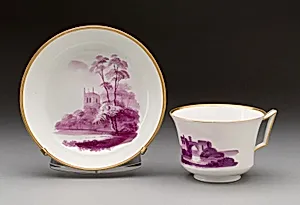
Cup and Saucer
c. 1820
Medium
Porcelain with monochrome purple and gilding
Dimensions
Cup: 7.1 × 12.1 cm (2 13/16 × 4 3/4 in.) diam. 10.2 cm (4 in.) Saucer: H. 3.5 cm (1 3/8 in.) diam. 15.6 cm (6 1/8 in.)
Classification
drinking vessel
Department
Applied Arts of Europe
Museum
Art Institute of Chicago
Accession Number
15033
Rights
Public Domain
Art Historical Context
This elegant cup and saucer, crafted around 1820 by the renowned Wedgwood Manufactory, exemplifies the refined porcelain traditions of early nineteenth-century Europe. Produced in Britain during the Regency period, the set reflects the era’s growing appreciation for delicate tableware among the expanding middle and upper classes. As part of the Applied Arts of Europe collection at the Art Institute of Chicago, it serves as a drinking vessel that highlights the intersection of industrial innovation and artistic craftsmanship in everyday luxury objects. The monochrome purple decoration, paired with delicate gilding, demonstrates sophisticated techniques typical of Wedgwood’s output. Porcelain’s smooth surface allowed for precise, elegant patterning, while the gold accents added a touch of opulence suitable for formal tea services. Such pieces were not merely functional but also status symbols, showcasing the manufacturer’s ability to blend utility with ornamental beauty. Measuring just over four inches in diameter for the cup, this intimate set invites viewers to appreciate the tactile and visual qualities of fine porcelain. It offers a glimpse into the social rituals of the time, when sharing tea became an important cultural practice across Europe.
About the Artist
Wedgwood Manufactory
Wedgwood Manufactory, founded on 1 May 1759 by Josiah Wedgwood in Burslem, Staffordshire, England, revolutionized ceramics during the Industrial Revolution. Born into a family of potters, Josiah apprenticed under his elder brother Thomas at the Churchyard Works from age 14, mastering traditional techniques before partnering with Thomas Whieldon from 1754 to 1759, where he honed innovative glazes. ...