
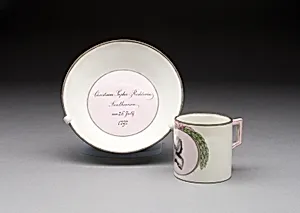
Cup and Saucer
Medium
Hard-paste porcelain and polychrome enamels
Dimensions
Cup: H. 5.6 cm (2 3/16 in.) diam. 5.6 cm (2 3/16 in.) Saucer: H. 2.7 cm (1 1/16 in.) diam. 12.5 cm (4 15/16 in.)
Classification
drinking vessel
Department
Applied Arts of Europe
Museum
Art Institute of Chicago
Accession Number
64578
Rights
Public Domain
Art Historical Context
This delicate cup and saucer, by the renowned Meissen Porcelain Manuf in 1797, the pinnacle of 18th-century European porcelain. Produced at the factory founded in 1710 near Dresden, Germany—the first in Europe to successfully replicate Chinese hard-paste porcelain—this piece measures a dainty cup height of 5.6 cm and saucer diameter of 12.5 cm. The medium of hard-paste porcelain, fired at high temperatures for exceptional durability and translucency, combined with polychrome enamels, for intricate, colorful decorations that mimicked fine painting on canvas. Meissen's innovations revolutionized applied arts, transforming porcelain from an exotic import into a symbol of luxury and refinement across European courts and bourgeois homes. By the late 1700s, amid the Enlightenment's taste for elegance, such drinking vessels were essential to the rising rituals of tea and coffee drinking, blending functionality with opulence. The enamels, applied overglaze and fired at lower temperatures, ensured lasting brilliance without fading. Visitors to the Art Institute of Chicago's Department of Applied Arts of Europe can appreciate how this unassuming yet masterful object reflects Meissen's enduring legacy: bridging Eastern techniques with Western creativity, and elevating everyday indulgence to high art.
About the Artist
Meissen Porcelain Manufactory
The Meissen Porcelain Manufactory, established on June 6, 1710, by Augustus II the Strong, Elector of Saxony and King of Poland, in the Albrechtsburg castle at Meissen near Dresden, marked Europe's breakthrough in producing true hard-paste porcelain. Building on experiments by physicist Ehrenfried Walther von Tschirnhaus and alchemist Johann Friedrich Böttger, who perfected the formula using local...