
Cup (part of a service)
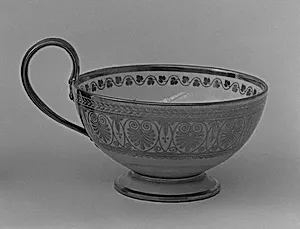
Medium
Hard-paste porcelain
Dimensions
2 7/8 × 3 3/4 in. (7.3 × 9.5 cm)
Classification
Ceramics-Porcelain
Culture
French, Sèvres
Department
European Sculpture and Decorative Arts
Museum
Metropolitan Museum of Art, New York, NY
Credit
Gift of Miss Sylvia Such, 1951
Accession Number
51.187.5
Rights
Public Domain
Art Historical Context
This delicate cup, crafted around 1845 by the renowned Sèvres Manuf with contributions from artist Jean-Louis Moyez, the pinnacle of 19th-century French porcelain. Produced at the royal manufactory in Sèvres near Paris, it forms part of a larger service—likely for tea or coffee—intended for elegant dining. Measuring just 2 7/8 × 3 3/4 inches, its petite scale belies the technical mastery involved, showcasing the factory's prestige as a supplier to European nobility and the bourgeoisie during the July Monarchy. Made from hard-paste porcelain, a durable and finely translucent material perfected by Sèvres in the late 18th century, the cup highlights advanced ceramic techniques. Hard-paste, fired at high temperatures, allowed for intricate gilding and painting that withstood repeated use while retaining brilliance. Moyez, a skilled decorator, likely contributed to its ornate finishes, reflecting Sèvres' signature style of opulent neoclassicism blended with romantic flourishes. Housed in the Metropolitan Museum of Art's European Sculpture and Decorative Arts Department (gift of Miss Sylvia Such, 1951), this piece offers a glimpse into France's cultural heritage, where porcelain was both a luxury good and a symbol of national pride. Visitors can appreciate how such objects elevated everyday rituals into moments of refined beauty.
About the Artist
Sèvres Manufactory|Jean-Louis Moyez · 1740–present
The Sèvres Manufactory, one of Europe's premier porcelain producers, was established in 1740 as the Manufacture de Vincennes under the patronage of Queen Marie Leszczyńska, who sought to rival Meissen and Chantilly porcelains with French soft-paste innovations. Initially a private venture, it relocated to Sèvres in 1756 in a purpose-built facility designed by architect Laurent Lindet near Madame d...