
Cup (part of a service)
18th century
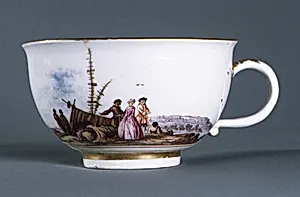
Medium
Hard-paste porcelain
Dimensions
1 13/16 × 3 1/4 in. (4.6 × 8.3 cm)
Classification
Ceramics-Porcelain
Culture
German, Meissen
Department
European Sculpture and Decorative Arts
Museum
Metropolitan Museum of Art, New York, NY
Credit
Gift of the Duchess Pini di San Miniato, 1982
Accession Number
1982.293.5
Rights
Public Domain
Tags
Art Historical Context
This delicate cup, crafted by the renowned Meissen Manufactory in collaboration with modeler Christian Friedrich Herold the 18th century exemplifies the pinnacle of early European porcelain artistry. As part of a larger service—likely intended for aristocratic tea or coffee rituals—it reflects the opulent rococo tastes of the Saxon court under Augustus the Strong, Meissen's royal patron. Herold, master sculptor at the factory, contributed to its intricate figural designs, possibly featuring elegant scenes of men and women, evoking the gallant social life of the era. Meissen's breakthrough in hard-paste porcelain, achieved around 1710, revolutionized ceramics by mimicking the translucent quality of prized Chinese export wares while enabling finer modeling and vivid overglaze enameling. This small cup (just 1 13/16 × 3 1/4 inches) showcases the technical virtuosity of firing at high temperatures for durability and sheen, techniques guarded as state secrets. Its survival highlights porcelain's role as a symbol of luxury and national pride in Germany. Today, this gift to the Metropolitan Museum of Art from the Duchess Pini di San Miniato in 1982 invites us to appreciate how everyday objects became canvases for cultural splendor, bridging functionality and fine art in Europe's decorative arts tradition.
About the Artist
Meissen Manufactory|Christian Friedrich Herold · 1710–present
The Meissen Manufactory, established on June 6, 1710, by Augustus the Strong, Elector of Saxony and King of Poland, marked the dawn of true hard-paste porcelain production in Europe. Nestled at Albrechtsburg Castle in Meissen near Dresden, the Royal Polish and Electoral Saxon Porcelain Manufactory arose from alchemical experiments begun in 1708 by physicist Ehrenfried Walther von Tschirnhaus and p...