
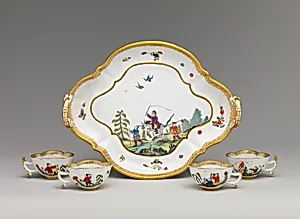
Cup (part of a set)
ca. 1740
Medium
Hard-paste porcelain
Dimensions
Overall (confirmed): 1 3/8 × 3 1/16 × 2 1/16 in. (3.5 × 7.8 × 5.2 cm)
Classification
Ceramics-Porcelain
Culture
German, Meissen
Department
European Sculpture and Decorative Arts
Museum
Metropolitan Museum of Art, New York, NY
Credit
Gift of Alastair Bradley Martin, 1950
Accession Number
50.192.3
Rights
Public Domain
Tags
Art Historical Context
This delicate cup, crafted by the renowned Meissen Manufactory 1740, exemplifies the golden age of European porcelain production As the first factory in Europe to successfully produce hard-paste porcelain durable, translucent material long monopolized by China—Meissen revolutionized decorative arts. Founded in 1710 near Dresden, Germany, the manufactory supplied royalty and nobility with luxurious tableware, blending technical innovation with artistic flair during the Rococo era's love for ornate elegance. Adorned with motifs of playful boys amid blooming flowers and lush plants, this petite cup (just over 3 inches wide) was likely part of a matching set for chocolate or coffee service, a fashionable indulgence of the 18th-century elite. Meissen artisans employed masterful techniques like underglaze painting and gilding, achieving vibrant colors and fine details that mimicked nature's intricacy while showcasing the material's glassy sheen. A gift to the Metropolitan Museum of Art in 1950, this piece highlights Meissen's cultural prestige, symbolizing Germany's leadership in ceramics and the opulent tastes of Enlightenment courts. Visitors will appreciate its whimsical charm, a tiny window into aristocratic life.
About the Artist
Meissen Manufactory · 1710–present
The Meissen Manufactory, established on June 6, 1710, by Augustus the Strong, Elector of Saxony and King of Poland, marked the dawn of true hard-paste porcelain production in Europe. Nestled at Albrechtsburg Castle in Meissen near Dresden, the Royal Polish and Electoral Saxon Porcelain Manufactory arose from alchemical experiments begun in 1708 by physicist Ehrenfried Walther von Tschirnhaus and p...