
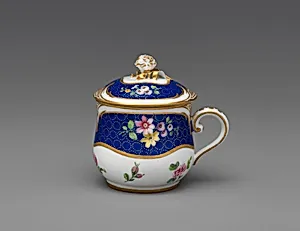
Cup with cover (pot à jus)
Medium
Soft-paste porcelain
Dimensions
Height: 3 in. (7.6 cm)
Classification
Ceramics-Porcelain
Culture
French, Sèvres
Department
European Sculpture and Decorative Arts
Museum
Metropolitan Museum of Art, New York, NY
Credit
Gift of Mrs. William C. Breed, 1964
Accession Number
64.174.57a, b
Rights
Public Domain
Tags
Art Historical Context
This delicate *Cup with cover (pot à jus)* from 1771 exemplifies the pinnacle of 18th-century French porcelain artistry at the renowned Sèvres Manuf. Crafted under the direction of Jean-Nicolas Bel, this petite vessel—standing just 3 inches tall—was designed as a sauce boat for serving *jus* (gravy or sauce) at lavish dinners. Produced during the reign of Louis XV, it reflects Sèvres' status as the royal porcelain factory, where luxury tableware symbolized wealth and refinement among the French aristocracy. Made of soft-paste porcelain, a French innovation prized for its creamy translucency and ability to hold intricate painted details, the cup likely features floral motifs—a hallmark of Sèvres' Rococo-inspired designs. This medium allowed artisans to achieve vibrant colors and gilding that hard-paste porcelain couldn't match at the time, making pieces like this both functional and ornamental treasures. Today, housed in the Metropolitan Museum of Art's European Sculpture and Decorative Arts Department (gift of Mrs. William C. Breed, 1964), it offers a glimpse into the opulent dining culture of Versailles-era France, where even the smallest utensils were feats of technical and aesthetic mastery.
About the Artist
Sèvres Manufactory|Jean-Nicolas Le Bel · 1740–present
The Sèvres Manufactory, one of Europe's premier porcelain producers, was established in 1740 as the Manufacture de Vincennes under the patronage of Queen Marie Leszczyńska, who sought to rival Meissen and Chantilly porcelains with French soft-paste innovations. Initially a private venture, it relocated to Sèvres in 1756 in a purpose-built facility designed by architect Laurent Lindet near Madame d...