
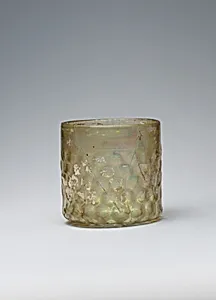
Cup with Molded Honeycomb Pattern
Unknown Artist
7th–10th century or later
Medium
Glass, colorless with yellow tinge; dip-molded, blown
Dimensions
H. 4 1/8 in. (10.5 cm) Diam. 4 in. (10.2 cm) Wt. 9.6 oz. (272.2 g)
Classification
Glass
Department
Islamic Art
Museum
Metropolitan Museum of Art, New York, NY
Credit
Rogers Fund, 1964
Accession Number
64.241.2
Rights
Public Domain
Art Historical Context
This delicate **Cup with Molded Honeycomb Pattern**, crafted from colorless glass with a subtle yellow tinge, exemplifies the ingenuity of early Islamic glassmakers from the 7th–10th century or later. Standing just 4 1/8 inches tall with a 4-inch diameter, its lightweight form (9.6 oz.) made it ideal for everyday use, whether for drinking water, wine, or rosewater in bustling medieval households across the Islamic world. The cup's standout feature is its intricate honeycomb texture, achieved through a sophisticated dip-molding technique: molten glass was gathered on a blowpipe, dipped into a patterned mold, and then blown to expand and imprint the design. This method, perfected during the Umayyad and Abbasid eras, allowed for mass production of decorative yet functional vessels, blending artistry with efficiency. The honeycomb motif evokes nature's geometry—bees' wax combs symbolizing harmony and abundance—common in Islamic decorative arts where geometric patterns held spiritual resonance. Housed in the Metropolitan Museum of Art's Islamic Art Department (acquired via the Rogers Fund in 1964), this anonymous masterpiece highlights glassmaking's golden age in regions like Syria or Egypt, where such cups graced tables from palaces to markets, bridging utility and beauty in daily life.