
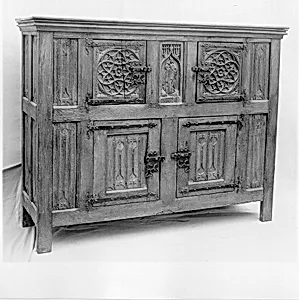
Cupboard
Unknown Artist
15th century
Medium
Wood, iron mounts
Dimensions
Overall: 53 3/8 x 68 1/8 x 21 1/4 in. (135.6 x 173 x 54 cm)
Classification
Woodwork-Furniture
Culture
South Netherlandish
Department
Medieval Art
Museum
Metropolitan Museum of Art, New York, NY
Credit
Gift of J. Pierpont Morgan, 1916
Accession Number
16.32.1
Rights
Public Domain
Art Historical Context
This imposing 15th-century cupboard the South Netherlands stands as a testament to the craftsmanship of late medieval woodwork. Crafted from wood with sturdy iron mounts, it measures an impressive 53 3/8 x 68 1/8 x 21 1/4 inches, making it a commanding presence in any grand hall. Donated to the Metropolitan Museum of Art in 1916 by J. Pierpont Morgan, it exemplifies the furniture produced in the prosperous region of the Southern Netherlands, where skilled artisans blended functionality with ornate design. In the Gothic era of the 1400s, such cupboards were more than mere storage—they served as status symbols in wealthy households, safeguarding linens, silver, or valuables behind locked doors reinforced by iron hinges and fittings. The South Netherlandish style often featured intricate joinery and carved panels, showcasing advanced woodworking techniques like mortise-and-tenon construction that ensured durability without modern nails. These pieces highlight the era's economic boom from trade and textile industries, reflecting a culture that valued both practicality and aesthetic grandeur. Today, this anonymous masterpiece invites us to appreciate the unsung heroes of medieval workshops, where form met function in harmony. Its survival offers a rare glimpse into daily life among the elite, bridging the artistry of the Middle Ages with our modern curiosity.