
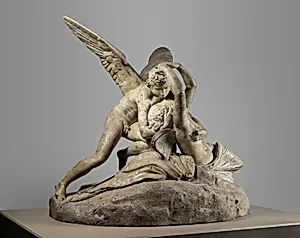
Cupid and Psyche
1794
Medium
Plaster
Dimensions
Overall: 53 × 59 1/2 × 32 in. (134.6 × 151.1 × 81.3 cm)
Classification
Sculpture
Culture
Italian, Rome
Department
European Sculpture and Decorative Arts
Museum
Metropolitan Museum of Art, New York, NY
Credit
Gift of Isidor Straus, 1905
Accession Number
05.46
Rights
Public Domain
Tags
Art Historical Context
Antonio Canova’s plaster model of Cupid and Psyche captures a tender moment from classical mythology, with the winged god of love embracing the mortal Psyche. Created in Rome in 1794, the work reflects Canova’s central role in the Neoclassical movement, which revived the balanced forms and idealized beauty of ancient Greek and Roman art. Working in the Eternal City, Canova drew inspiration from both antique sculpture and the dramatic narratives of the ancient world. The choice of plaster is significant: it served as a detailed preparatory model that allowed the artist to refine proportions and surface before carving marble versions. The composition emphasizes graceful anatomy, evident in the carefully rendered male nude figure of Cupid, highlighting Canova’s technical precision and sensitivity to human emotion. Such models were essential tools in his studio practice and offer visitors a glimpse into the creative process behind his celebrated finished marbles. Today this piece resides in the Metropolitan Museum of Art as a generous gift from Isidor Straus in 1905, preserving an intimate study that continues to convey the timeless story of love and transformation.
About the Artist
Antonio Canova · 1757–1822
Antonio Canova, born on November 1, 1757, in the small town of Possagno in the Republic of Venice, was immersed in sculpture from childhood. His father, Pietro Canova, a stonecutter, died when Antonio was just four, prompting his mother, Angela Zardo Fantolin, to remarry and place him under the care of his paternal grandfather, Pasino Canova. A skilled stonemason and sculptor of late Baroque altar...