
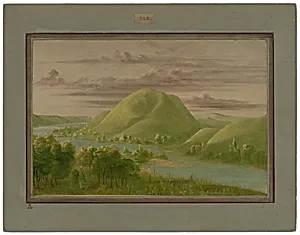
Curious Grassy Bluffs, St. Peter's River
1861/1869
Medium
oil on canvas
Dimensions
overall: 37.5 x 56.3 cm (14 3/4 x 22 3/16 in.)
Classification
Painting
Department
CAB
Museum
National Gallery of Art, Washington, D.C.
Credit
Paul Mellon Collection
Accession Number
1965.16.190
Rights
Public Domain
Art Historical Context
George Catlin's *Curious Grassy Bl, St. Peter's River* (1861/1869) captures the rugged beauty of the American Midwest in this intimate oil on canvas landscape, measuring 37.5 x 56.3 cm. Painted late in Catlin's career, it depicts the dramatic grassy bluffs along the St. Peter's River (now the Minnesota River), a region central to early 19th-century frontier exploration. Catlin, a pioneering artist known for his documentary-style portraits of Native American life, here shifts focus to the untamed natural environment that framed those cultures. As a key figure in American Romanticism, Catlin traveled extensively in the 1830s among Plains tribes, sketching hundreds of works to preserve a vanishing world amid westward expansion. This later painting, likely based on earlier field studies, reflects his lifelong mission to celebrate the "noble savage" and pristine wilderness before industrialization. The oil medium allows Catlin's masterful rendering of textured grasses, earthy tones, and sweeping vistas, evoking both awe and urgency. Housed in the National Gallery of Art's Paul Mellon Collection, this piece underscores Catlin's enduring legacy as a visual chronicler of pre-settlement America, inviting viewers to ponder the fragile harmony between landscape and indigenous heritage.
About the Artist
George Catlin · 1796–1872
George Catlin (1796–1872), born in Wilkes-Barre, Pennsylvania, to Putnam Catlin and Polly Sutton—who had been captured by Native Americans during the 1778 Battle of Wyoming—initially pursued a legal career. Trained at Litchfield Law School, he was admitted to the bar in 1819 but abandoned law after two years to study art in Philadelphia in 1823. Self-taught as a portraitist, Catlin quickly gained ...