
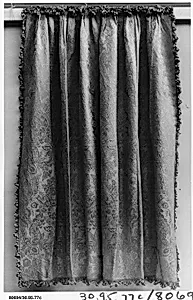
Curtain
Unknown Artist
1720–30
Medium
Silk
Dimensions
8 ft. 4 in. × 26 1/2 in. (254 × 67.3 cm)
Classification
Textiles-Woven
Culture
Italian
Department
European Sculpture and Decorative Arts
Museum
Metropolitan Museum of Art, New York, NY
Credit
Theodore M. Davis Collection, Bequest of Theodore M. Davis, 1915
Accession Number
30.95.77c
Rights
Public Domain
Art Historical Context
This elegant silk curtain, woven in Italy around 1720–30, exemplifies the opulence of early 18th-century European decorative arts. Standing over eight feet tall but only about two feet wide, it likely served as a grand panel for a bed canopy, window treatment, or architectural niche in a lavish palazzo. Crafted from lustrous silk, the textile showcases the era's mastery of weaving techniques, where intricate patterns were created directly on the loom, blending functionality with high artistry. Hailing from Italy's vibrant textile tradition—centered in cities like Florence and Venice—this piece reflects the Baroque period's dramatic flair transitioning toward Rococo exuberance. Silk production was a cornerstone of Italian luxury exports, symbolizing wealth and status among the nobility. Its woven structure, classified as a textile, highlights the labor-intensive process of integrating metallic threads or motifs for shimmering effects, though specific designs remain unrecorded here. Now part of the Metropolitan Museum of Art's Theodore M. Davis Collection, this curtain invites us to imagine the sumptuous interiors of the Venetian elite, where such fabrics draped everyday life in splendor. A testament to anonymous artisans' skill, it underscores textiles' role as wearable architecture in historical homes.