
Cushion Cover
Qing dynasty (1644–1911), 1720/50
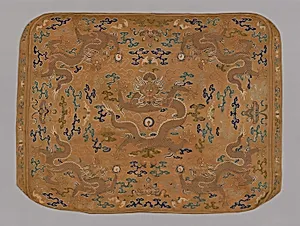
Medium
Brocade
Dimensions
170.2 × 137.8 cm (67 × 54 1/4 in.)
Classification
textile
Department
Textiles
Museum
Art Institute of Chicago
Accession Number
22539
Rights
Public Domain
Art Historical Context
This exquisite **Cushion Cover**, by Manchu artisans during China's Qing dynasty (16441911) around 1720–50, exemplifies the opulence of mid-18th-century imperial arts. Woven in luxurious brocade—a high-relief silk fabric prized for its shimmering metallic threads and complex Jacquard-like patterns—this piece measures an impressive 170.2 × 137.8 cm, suggesting it adorned large seating cushions or ceremonial furnishings in elite households. Under Manchu rule, particularly during the reigns of the Yongzheng or early Qianlong emperors, textiles like brocade were produced in imperial workshops, symbolizing prosperity, power, and cultural refinement. Brocade's significance lay in its labor-intensive weaving technique, which interlaces warp and weft threads to create raised, durable motifs, often reserved for courtly or high-status use. This cover reflects the Qing court's fusion of Manchu nomadic traditions with refined Han Chinese aesthetics. Today, housed in the Art Institute of Chicago's Textiles Department, it invites us to appreciate the tactile splendor of Qing craftsmanship—where every thread tells a story of technical mastery and imperial splendor. A true gem for textile enthusiasts!
About the Artist
Manchu
"Manchu" is a cultural and ethnic designation used in museum collection records to identify objects, textiles, costumes, and decorative arts associated with the Manchu people, a Tungusic group originating from the regions northeast of the Great Wall of China. The Manchus rose to political dominance in 1644 when they conquered the declining Ming dynasty and established the Qing dynasty, which ruled...