
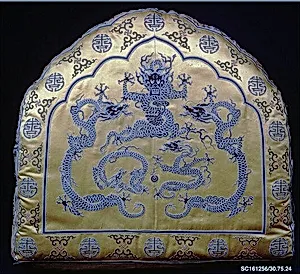
Cushion Cover for Throne
Unknown Artist
Medium
Silk; on silk
Dimensions
36 x 38 3/4 in. (91.44 x 98.42 cm)
Classification
Textiles-Embroidered
Culture & Period
China · Qing dynasty (1644–1911), Kangxi period (1662–1722)
Department
Asian Art
Museum
Metropolitan Museum of Art, New York, NY
Credit
Bequest of William Christian Paul, 1929
Accession Number
30.75.24
Rights
Public Domain
Tags
Art Historical Context
This exquisite *Cushion Cover for*, crafted during China's Qing dynasty Kangxi period (16621722), exemplifies the imperial opulence of early Qing court life. Measuring 36 x 38 3/4 inches, this large embroidered silk textile was designed to adorn a throne, a seat of ultimate power reserved for the emperor. Produced in an era of cultural flourishing under Emperor Kangxi—a renowned patron of the arts—it reflects the dynasty's mastery of luxury crafts, where silk weaving and embroidery reached unparalleled heights. The cover's intricate embroidery on silk features dragons, potent symbols of imperial authority, strength, and divine favor in Chinese cosmology. These mythical creatures, often depicted in dynamic motion amid clouds or flames, underscored the emperor's mandate from heaven. Silk, China's ancient "secret" export, was the ideal medium: lightweight yet durable, its shimmering surface enhanced the threads' luster through techniques like satin stitch and couching, creating vivid depth and texture. Housed in the Metropolitan Museum of Art's Asian Art Department (Bequest of William Christian Paul, 1929), this rare survivor offers a tactile glimpse into forbidden palace rituals. Imagine the rustle of silk under royal robes— a testament to Qing artistry's enduring allure.