
Cut-out
Classification
metalwork
Department
Smithsonian Collection
Museum
Smithsonian American Art Museum
Credit
Gift of Sullivan Goss-An American Gallery
Accession Number
2014-42-5
Rights
Public Domain
About this artwork
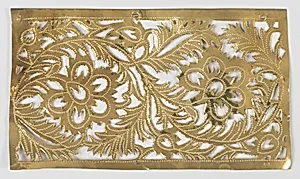
Trailing foliate vine with stylized flowerheads on a bordered rectangular panel
Art Historical Context
Lockwood de Forest’s *Cut-out* is a striking example of late-nineteenth-century American metalwork. Created between 1881 and 1890, the panel features a graceful trailing vine punctuated by stylized flowerheads, all contained within a crisp border. The openwork technique allows light and shadow to play across the surface, turning the metal into a delicate, almost lace-like screen. De Forest, an American artist deeply influenced by the Aesthetic Movement, spent much of the 1880s traveling and working in India. There he established workshops that blended Western design sensibilities with traditional Indian metalworking skills. This panel reflects that cross-cultural exchange, combining naturalistic motifs popular in Victorian decorative arts with the rhythmic, flattened patterns favored in South Asian ornament. Now part of the Smithsonian American Art Museum’s collection, *Cut-out* highlights how American designers of the period looked beyond national borders for inspiration. Its elegant simplicity and emphasis on handcraft speak to a broader cultural moment when decorative objects were celebrated as works of art in their own right.