
Cut-out
Medium
metalwork
Classification
metalwork
Department
Smithsonian Collection
Museum
Smithsonian American Art Museum
Credit
Gift of Sullivan Goss-An American Gallery
Accession Number
2014-42-6
Rights
Public Domain
About this artwork
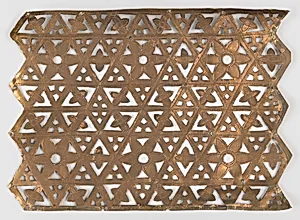
the rectangular sheet of thin copper with pointed borders on the side, pierced with an arrangment of triangles and flowerheads in a geometric pattern
Art Historical Context
Lockwood de Forest’s *Cut-out* (1881–90) showcases the refined artistry of American metalwork during the late nineteenth century. Created from a thin rectangular sheet of copper with pointed borders, the piece features a delicate arrangement of triangles and flowerheads pierced through the metal in a balanced geometric pattern. This technique transforms a simple sheet into an intricate, lace-like design that plays with light and shadow, highlighting the artist’s attention to both form and ornament. De Forest, an American artist active from 1850 to 1932, brought a thoughtful approach to decorative arts. Works like this one reflect the period’s growing appreciation for craftsmanship in everyday objects, where metalwork served not only functional purposes but also as a medium for artistic expression. The pierced copper invites viewers to consider how industrial materials could be elevated through handwork and pattern. Housed in the Smithsonian American Art Museum, *Cut-out* offers a glimpse into the creative possibilities of metal as both structure and decoration. Its elegant simplicity continues to demonstrate how artists of the era blended utility with beauty in unexpected ways.