
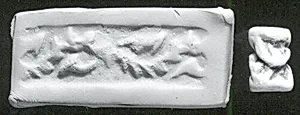
Cylinder seal with geometric design
Unknown Artist
1st millennium BCE
Medium
Faience
Dimensions
0.55 in. (1.4 cm)
Classification
Faience-Cylinder Seals
Culture & Period
Iranian · Iron Age
Department
Ancient Near Eastern Art
Museum
Metropolitan Museum of Art, New York, NY
Credit
Anonymous Gift, 1970
Accession Number
1970.68.2
Rights
Public Domain
Art Historical Context
This petite cylinder seal, crafted in vibrant faience during Iran's Iron Age (1st BCE), exemplifies the ingenuity of Ancient Near Eastern artisans. Measuring just 0.55 (1.4 cm) tall, it features a geometric design that would have been rolled across soft clay to create repeated impressions—serving as a signature for ownership, trade, or official documents. Housed in the Metropolitan Museum of Art's Ancient Eastern Art Department, this anonymous 1970 gift offers a window into everyday administrative life in ancient Iran. Faience, a glazed composite of quartz, lime, and copper for its striking turquoise hue, was a prized medium for seals due to its durability and luminous finish. Unlike stone seals, faience allowed for intricate patterns and bright colors that stood out on clay tablets. Geometric motifs like those here symbolized order and protection, reflecting the structured societies of the Iron Age, when iron tools spurred economic growth and expanded trade networks across the Near East. Though the artist remains unknown, this seal's precision highlights masterful lapidary techniques, underscoring the cultural role of seals in diplomacy and commerce. A tiny marvel, it connects us to the bustling world of ancient Iranian scribes and merchants.