
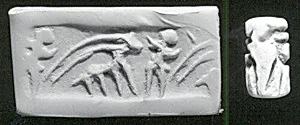
Cylinder seal with two-figure contest scene
Unknown Artist
1st millennium BCE
Medium
Faience
Dimensions
0.71 in. (1.8 cm)
Classification
Faience-Cylinder Seals
Culture & Period
Iranian · Iron Age
Department
Ancient Near Eastern Art
Museum
Metropolitan Museum of Art, New York, NY
Credit
Anonymous Gift, 1970
Accession Number
1970.68.1
Rights
Public Domain
Art Historical Context
This exquisite cylinder seal, crafted in faience during Iran's Iron Age in the 1st millennium, offers a glimpse into the ancient Near Eastern world of administration, ritual, and symbolism. Measuring just 0.71 (1.8 cm) in height, these diminutive objects were rolled across wet clay to create repeated impressions, serving as personal signatures on documents, goods, or sealings. Faience, a glazed composite of quartz and frit fired to a vibrant turquoise hue, was prized for its luminous quality, mimicking precious lapis lazuli while being more accessible—a testament to innovative ancient materials technology. The seal's carved scene depicts a dynamic two-figure contest, a motif common in Iranian art that likely evokes themes of heroism, combat, or divine struggle, reflecting martial ethos of Iron Age societies. Such imagery underscores the cultural importance of seals as talismans of power and identity amid emerging empires like the Medes and early Achaemenids. Housed in the Metropolitan Museum of Art's Ancient Near Eastern Art Department through an anonymous 1970 gift, this artifact bridges the everyday and the mythical, inviting us to ponder the lives of its long-lost owners. (198 words)