
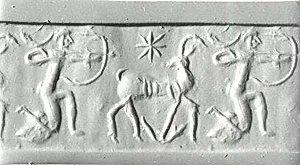
Cylinder seal with hunting scene
Unknown Artist
ca. 6th century BCE
Medium
Variegated brown Limestone
Dimensions
0.83 in. (2.11 cm)
Classification
Stone-Cylinder Seals
Culture & Period
Elamite · Neo-Elamite
Department
Ancient Near Eastern Art
Museum
Metropolitan Museum of Art, New York, NY
Credit
Gift of Martin and Sarah Cherkasky, 1984
Accession Number
1984.383.23
Rights
Public Domain
Tags
Art Historical Context
This exquisite cylinder seal, crafted from variegated brown limestone around the 6th century BCE, hails from the Neo-Elamite period in ancient Elam—a sophisticated civilization in southwestern Iran. Measuring just 0.83 inches (2.11 cm) in height, these small yet intricate objects were rolled across wet clay to create repeated impressions, serving as seals for documents, goods, or administrative purposes. Donated to the Metropolitan Museum of Art 1984 by Martin and Sarah Cherkask, it exemplifies the artistry of the Ancient Near Eastern world. The seal depicts a dynamic hunting scene, featuring men armed with bows and arrows pursuing animals—a common motif symbolizing power, fertility, and the elite's prowess in Elamite culture. Carved in fine detail on the stone's curved surface, the design highlights the mastery of intaglio techniques, where incisions catch the clay to form raised images when impressed. Such seals were not mere tools but status symbols, often worn as jewelry by officials. Neo-Elamite seals like this one bridge Mesopotamian traditions and local innovations, offering glimpses into daily life and mythology. Though the artist remains unknown, the work's precision underscores Elam’s enduring legacy in glyptic art, bridging the gap between utility and aesthetic brilliance.