
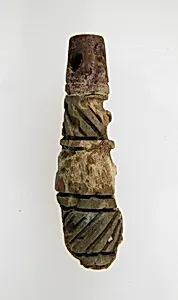
Cylindrical Pendant
Unknown Artist
6th–7th century
Medium
Bone
Dimensions
Overall: 1 5/16 x 3/8 in. (3.3 x 1 cm)
Classification
Bone
Culture
Frankish
Department
Medieval Art
Museum
Metropolitan Museum of Art, New York, NY
Credit
Gift of J. Pierpont Morgan, 1917
Accession Number
17.193.31
Rights
Public Domain
Art Historical Context
This delicate *Cylindrical Pendant*, crafted from bone by an unknown Frankish artist in the 6th–7th century, offers a glimpse into early medieval life in Francia. Measuring just 1 5/16 x 3/8 inches (3.3 x 1 cm), its small, portable size suggests it was worn as personal jewelry—perhaps suspended from a necklace or belt—serving both decorative and possibly protective purposes, like an amulet. Bone was a practical and abundant medium during the Merovingian period, when the Franks ruled much of western Europe after the fall of Rome. Artisans skillfully carved and polished it, highlighting the material's natural texture while demonstrating resourcefulness in an era of limited metalworking for everyday items. This pendant reflects Frankish cultural transitions, blending pagan traditions with emerging Christian influences, and underscores the importance of personal adornments in signaling identity and status. Now housed in the Metropolitan Museum of Art's Medieval Art department, thanks to a 1917 gift from J. Pierpont Morgan, it invites us to ponder the intimate stories of its long-ago wearer. A testament to understated craftsmanship, it bridges the artistry of antiquity and the Middle Ages.