
Key Handle
Unknown Artist
1st–7th century
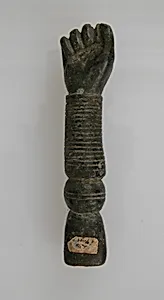
Medium
Copper alloy
Dimensions
Overall: 2 15/16 x 11/16 x 9/16 in. (7.5 x 1.7 x 1.5 cm)
Classification
Metalwork-Copper alloy
Culture
Roman
Department
Medieval Art
Museum
Metropolitan Museum of Art, New York, NY
Credit
Purchase, De Souhami Collection, Rogers Fund, 1906
Accession Number
06.176.22
Rights
Public Domain
Tags
Art Historical Context
This exquisite copper alloy key handle, from the 1st to 7th century, exemplifies the refined metalworking of the Roman world. Measuring just under 3 inches long, its compact form suggests it adorned a practical door or chest key, transforming an everyday tool into a tactile work of art. The tag "Hands" hints at anthropomorphic design, likely featuring sculpted hands that invited the user to grasp them intimately, blending functionality with subtle human expression. Crafted during the expansive Roman Empire and into late antiquity, this object reflects a culture where keys symbolized authority, security, and domestic control—often linked to deities like Janus, the guardian of thresholds. Copper alloys, prized for their durability and golden sheen, were cast or hammered using lost-wax techniques, allowing intricate details that have endured over 1,500 years. Housed in the Metropolitan Museum of Art's Medieval Art department (acquired in 1906 via the De Souhami Collection and Rogers Fund), it bridges Roman craftsmanship with early medieval traditions. Though by an unknown artist, the handle's survival speaks to the artistry embedded in Roman daily life, reminding us how even humble tools carried cultural weight in an era of grand engineering and personal ritual.