
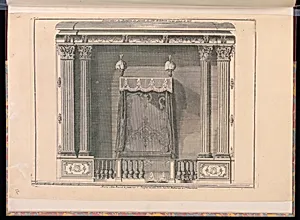
Décoration de Chambre de parade du côté de l’estrade ou est placé le liet
Classification
Department
Smithsonian Collection
Museum
Smithsonian American Art Museum
Credit
Purchased for the Museum by the Advisory Council
Accession Number
1921-6-237-12
Rights
Public Domain
About this artwork
Research in Progress
Art Historical Context
Created around 1765 by the French printmaker André Basset, this work presents a detailed design for the decoration of a grand parade chamber, focusing on the ceremonial bed platform known as the estrade. Basset, active during the final decades of the Rococo era, specialized in capturing the refined interior schemes favored by French aristocracy. The print likely served both as a record of fashionable taste and as a model for craftsmen and patrons seeking to emulate courtly elegance. In mid-eighteenth-century France, such decorative prints played an important role in spreading new styles beyond Paris. They translated the fluid lines, gilded ornament, and theatrical arrangements of royal and noble residences into reproducible images that could guide upholsterers, carvers, and architects. Although the precise technique remains unrecorded, the sheet belongs to a long tradition of architectural and furniture prints that helped shape domestic luxury across Europe. Now preserved in the Smithsonian American Art Museum, this example offers visitors a glimpse into the collaborative world of designers and printmakers who defined the visual language of the period. Its purchase by the museum’s Advisory Council underscores the continuing value of these works for understanding how eighteenth-century taste was both created and circulated.