
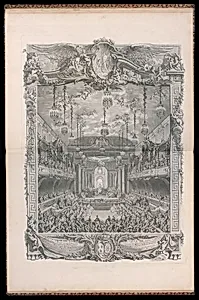
Décoration de la salle de spectacle, construit dans le manège couvert de la grande écurie à Versailles, pour la représentation de la Princesse de Navarre Comédie Ballet, donnée à l’occasion du Mariage de Louis Dauphin de France avec Marie Thérèse Infante d’Espagne, le XXIII février M.DCCLV.
Classification
Bound print
Department
Smithsonian Collection
Museum
Smithsonian American Art Museum
Credit
Purchased for the Museum by the Advisory Council
Accession Number
1921-6-205-6
Rights
Public Domain
About this artwork
Research in Progress
Art Historical Context
This exquisite bound print captures the grandeur of a temporary spectacle hall at Versailles, ingeniously constructed within the covered riding school of the Grand Stable. Created by the Menus-Plaisirs du Roi—the royal workshop tasked with crafting opulent sets, costumes, and decorations for court entertainments—it depicts the stage design for Jean-Philippe Rameau's *La Princesse de Navarre*, a lavish comédie-ballet performed on February 23, 1755. The event celebrated the marriage of Louis, Dauphin of France (future Louis XVI's father), to Maria Teresa, Infanta of Spain, embodying the splendor of Louis XV's reign. In the opulent world of 18th-century Versailles, such productions were spectacles of power and artistry, blending music, dance, and theater to dazzle nobility. The Menus-Plaisirs exemplified French Rococo ingenuity, transforming utilitarian spaces like stables into immersive theaters with intricate scenery, illusory perspectives, and gilded motifs. This print, likely an engraved record, preserved the ephemeral magic for posterity, offering a window into absolutist pomp just before the Revolution. Today, housed in the Smithsonian American Art Museum, it highlights transatlantic cultural exchanges. Though research continues, it evokes the fleeting brilliance of royal festivities, where art served the monarchy's magnificence. (198 words)