
Dagger
Unknown Artist
500–700
Medium
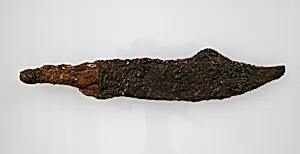
Iron with traces of wood hilt or sheath
Dimensions
Overall: 6 x 1 1/8 x 1/4 in. (15.2 x 2.9 x 0.6 cm)
Classification
Metalwork-Iron
Culture
Frankish
Department
Medieval Art
Museum
Metropolitan Museum of Art, New York, NY
Credit
Gift of J. Pierpont Morgan, 1917
Accession Number
17.193.191
Rights
Public Domain
Art Historical Context
This slender Frankish dagger, dating to the early Medieval period (500–700 AD), offers a glimpse into the martial world of the Merovingian Franks, who dominated much of Western Europe after the fall of Rome. Crafted during a time of migration, conquest, and kingdom-building under rulers like Clovis I, such weapons were essential for personal defense and status among warriors. Its compact size— just 6 inches long—s it was a concealed sidearm, ideal for close combat or everyday carry by a noble or fighter. Forged from iron with faint traces of a wooden hilt or sheath, the dagger exemplifies early medieval metalwork techniques. Iron was prized for its durability, hammered and shaped without advanced alloys, while the organic wood components—now mostly decayed—hint at practical, perishable handles wrapped for grip. These utilitarian objects rarely survive intact, making this example a rare survivor from Frankish burials or hoards. A generous gift from J. Pierpont Morgan in 1917, it now resides in The Metropolitan Museum of Art's Medieval Art collection, reminding us how everyday tools like this dagger bridged the ancient and medieval worlds, embodying the grit and ingenuity of Frankish culture.