
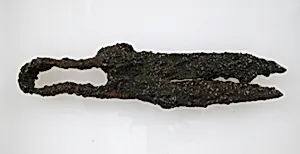
Scissors
Unknown Artist
7th century
Medium
Iron
Dimensions
Overall: 5 3/4 x 1 1/4 x 1/2 in. (14.6 x 3.1 x 1.3 cm)
Classification
Metalwork-Iron
Culture
Frankish
Department
Medieval Art
Museum
Metropolitan Museum of Art, New York, NY
Credit
Gift of J. Pierpont Morgan, 1917
Accession Number
17.193.287
Rights
Public Domain
Art Historical Context
Step into the world of early medieval Europe with these remarkable 7th-century Frank scissors, a humble yet revealing artifact from the Metropolitan Museum Art's Medieval Art collection Crafted from iron and measuring just 5 3/4 x 1 1/4 x 1/2 inches, this compact tool exemplifies the everyday ingenuity of the Merovingian Franks, who dominated much of western Europe during this era. Donated by J. Pier Morgan in 1917, it offers a tangible glimpse into a time when such metalwork was both functional and finely executed. Forged from iron—a material whose working required considerable skill in smelting and hammering—these scissors highlight the advanced metallurgical techniques of Frankish craftsmen. The blades, likely joined by a riveted pivot, were designed for precision tasks like cutting cloth, hair, or parchment, underscoring their role in daily life, trade, and personal grooming. In a period before widespread industrialization, iron tools like this were prized possessions, often buried with their owners as grave goods, symbolizing status and utility. This unassuming object bridges art and archaeology, illuminating Frankish culture's blend of practicality and craftsmanship amid the transition from late antiquity to the Middle Ages. It reminds us how even the smallest artifacts can whisper stories of innovation and resilience.