
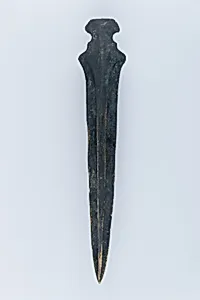
Dagger (Dirk) Blade
Unknown Artist
1500–1200 BCE
Medium
Bronze
Dimensions
L. 8 7/8 in. (22.5 cm); W. 1 5/8 in. (4.1 cm); Wt. 3 1/2 oz. (99.2 cm)
Classification
Daggers
Culture
Irish
Department
Arms and Armor
Museum
Metropolitan Museum of Art, New York, NY
Credit
Rogers Fund, 1948
Accession Number
48.157.3
Rights
Public Domain
Art Historical Context
This exquisite bronze dagger blade, dating to Ireland's Bronze Age (1500–1200 BCE), offers a glimpse into the martial world of ancient Celtic forebears. Crafted from bronze—a revolutionary alloy of copper and tin—this slender dirk blade measures 8⅞ inches long and weighs just 3½ ounces, making it both lethal and lightweight for close combat. Its simple yet functional form reflects the era's advancing metallurgy, likely produced through lost-wax casting, a technique that allowed for precise shaping and durability. In Bronze Age Ireland, such weapons were more than tools of war; they symbolized status and craftsmanship amid a society reliant on trade networks spanning Europe for raw metals. Hoards of similar blades found in rivers and bogs suggest ritual deposition, blending utility with spiritual significance. Though the artist remains unknown, this artifact highlights the anonymous mastery of early Irish smiths. Acquired through the Rogers Fund in 1948 and housed in The Metropolitan Museum of Art's Arms and Armor Department, it invites us to ponder the hands that forged it millennia ago—hands that bridged the Stone Age into a metallic new world.