
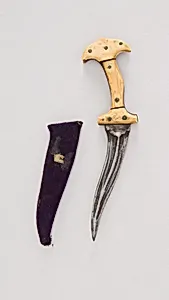
Dagger (Khanjarli) with Sheath
Unknown Artist
17th century
Medium
Steel, ivory, velvet, wood
Dimensions
H. with sheath 8 in. (20.3 cm); H. without sheath 7 7/8 in. (20 cm); H. of blade 4 3/4 in. (12.1 cm); W. 1 15/16 in. (4.9 cm); Wt. 3 oz. (85 g); Wt. of sheath 0.2 oz. (5.7 g)
Classification
Daggers
Culture
South Indian
Department
Arms and Armor
Museum
Metropolitan Museum of Art, New York, NY
Credit
Bequest of George C. Stone, 1935
Accession Number
36.25.1066a, b
Rights
Public Domain
Art Historical Context
This exquisite 17th-century South Indian dagger, known as a *khanjarli*, exemplifies the masterful fusion of functionality and artistry in arms and armor. Crafted from steel for its sharply curved blade—measuring just 4¾ inches long—the weapon features an ivory handle for a secure grip, housed in a slender sheath of wood wrapped in rich velvet. At only 8 inches tall with sheath and weighing a mere 3 ounces, its compact design made it ideal for close combat or concealed carry, reflecting the practical needs of warriors in the Deccan region. Originating from South India during a turbulent era of shifting empires, including the declining Vijayanagara and rising sultanates, the *khanjarli* served not just as a weapon but as a status symbol for nobility and fighters. The use of luxurious materials like ivory and velvet highlights the high level of craftsmanship, where South Indian artisans blended Islamic and Hindu influences in metalwork and ornamentation. Such daggers were often personalized, underscoring their owners' prestige. Today, this piece from the Metropolitan Museum of Art's Arms and Armor collection—bequeathed by George C. Stone in 1935—offers a window into the martial culture of pre-colonial India, where beauty and lethality coexisted in finely wrought steel.