
Dagger with Sheath
Unknown Artist
19th century
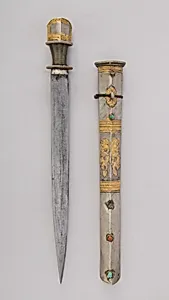
Medium
Steel, silver wire, silver, gold, coral, turquoise, gemstone
Dimensions
L. with sheath 15 9/16 in. (39.5 cm); L. without sheath 15 1/8 in. (38.4 cm); L. of blade 12 in. (30.5 cm); W. 1 9/16 in. (4 cm); D. 1 3/16 in. (3 cm); Wt. 8.8 oz. (249.5 g); Wt. of sheath 4.5 oz. (127.6 g)
Classification
Daggers
Culture
Bhutanese or Sikkimese
Department
Arms and Armor
Museum
Metropolitan Museum of Art, New York, NY
Credit
Bequest of Richard B. Seager, 1926
Accession Number
26.35.10a, b
Rights
Public Domain
Art Historical Context
This exquisite **Dagger with Sheath**, crafted in the 19th by an unknown Bhutanese or Sikkimese artisan, exemplifies the opulent arms of the Himalayan kingdoms. Measuring nearly 16 inches with its sheath, the dagger features a steel blade paired with a hilt and scabbard adorned in silver wire, silver, gold, coral, turquoise and gemstones. These lavish materials—precious metals and vividly colored stones sacred in Buddhist-influenced cultures—transform a functional weapon into a status symbol, likely reserved for nobility or ceremonial use. In Bhutan and Sikkim, such daggers bridged utility and artistry, showcasing masterful techniques like wirework, gilding, and inlay that rivaled jewelry. Turquoise and coral, symbols of protection and vitality in Tibetan traditions, highlight the object's spiritual significance amid the region's warrior aristocracy. Weighing just over a pound including its sheath, it balanced lethality with elegance. Now housed in the Metropolitan Museum of Art's Arms and Armor Department (Bequest of Richard B. Seager, 1926), this piece invites us to ponder the fusion of beauty and power in 19th-century Himalayan life.