
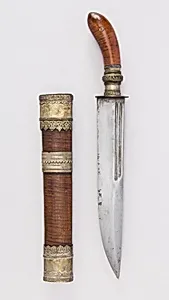
Knife with Sheath
Unknown Artist
19th century
Medium
Steel, wood, copper, silver
Dimensions
L. with sheath 13 1/8 in. (33.3 cm); L. without sheath 12 7/8 in. (32.7 cm); L. of blade 8 3/4 in. (22.2 cm); W. 1 7/8 in. (4.8 cm); Wt. 8.5 oz. (241 g); Wt. of sheath 3.2 oz. (90.7 g)
Classification
Daggers
Culture
Philippine, Moro
Department
Arms and Armor
Museum
Metropolitan Museum of Art, New York, NY
Credit
Bequest of George C. Stone, 1935
Accession Number
36.25.850a, b
Rights
Public Domain
Art Historical Context
This exquisite **Knife with Sheath** 19th-century Moro culture the Philippines exemplifies the masterful craftsmanship of Southeast Asian edged weapons. Crafted from steel for the blade, with a handle of wood adorned in copper and silver, and a matching sheath, it measures just over 13 inches long with its sheath. Weighing a mere 8.5 ounces (plus 3.2 for the sheath), its balanced design speaks to functionality for both combat and ceremonial use, typical of Moro daggers classified in the Arms and Armor collection at The Metropolitan Museum of Art. The Moro people, Muslim communities in the southern Philippines, were renowned warriors who resisted Spanish colonial forces throughout the 19th century. Weapons like this one were not merely tools of defense but symbols of status and identity, often featuring intricate metalwork that blended utility with artistry. The use of silver and copper suggests decorative inlays or fittings, highlighting the Moros' skill in working diverse metals—a technique rooted in Islamic and pre-colonial traditions. Bequeathed by George C. Stone in 1935, this piece offers a window into Moro heritage, where form met fierce functionality. Visitors will appreciate its compact power, a testament to a culture's enduring legacy of resilience and refined artisanship.