
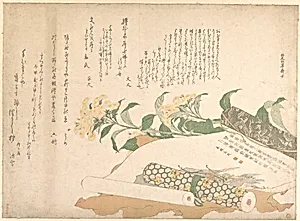
Daisies and Two Makimono
ca. 1800
Medium
Woodblock print (surimono); ink and color on paper
Dimensions
15 x 20 in. (38.1 x 50.8 cm)
Classification
Prints
Culture & Period
Japan · Edo period (1615–1868)
Department
Asian Art
Museum
Metropolitan Museum of Art, New York, NY
Credit
The Francis Lathrop Collection, Purchase, Frederick C. Hewitt Fund, 1911
Accession Number
JP662
Rights
Public Domain
Tags
Art Historical Context
**Daisies and Twoimono** is a delicate woodblock print (surimono) by Kitao Shigemasa, a ukiyo-e artist Japan's Edo period (ca. 1800). Shigemasa, known for his refined illustrations and prints blending nature and everyday elegance, captures a serene still life of blooming daisies alongside two makimono—traditional Japanese handscrolls. Measuring 15 x 20 inches, this ink and color on paper work exemplifies the exquisite craftsmanship of surimono, privately commissioned prints often created for poetic gatherings or New Year's celebrations. Produced during the vibrant Edo era (1615–1868), when woodblock printing flourished in urban centers like Edo (modern Tokyo), the artwork highlights advanced techniques such as precise color layering, subtle gradations (bokashi), and possibly mica or embossing for a luxurious sheen—hallmarks of surimono that set them apart from mass-produced ukiyo-e. Daisies, symbols of purity and simplicity in Japanese culture, contrast beautifully with the ornate makimono, evoking themes of transience and artistic appreciation central to Edo aesthetics. Housed in the Metropolitan Museum of Art's Asian Art Department as part of The Francis Lathrop Collection (acquired 1911), this piece offers visitors a window into Japan's golden age of printmaking, where everyday beauty was elevated to high art. A charming invitation to ponder nature's quiet poetry. (198 words)
About the Artist
Kitao Shigemasa · 1739–1820
Kitao Shigemasa (1739–1820), born in the bustling Nihonbashi district of Edo (modern Tokyo), emerged as a pivotal figure in ukiyo-e woodblock printing during Japan's Edo period. The eldest son of the bookseller Suharaya Mohei—from a lineage of publishers—Shigemasa, originally named Kitabatake Tarōkichi, was immersed in the world of printing from youth. Largely self-taught, he later studied under t...