
Dancer
1913
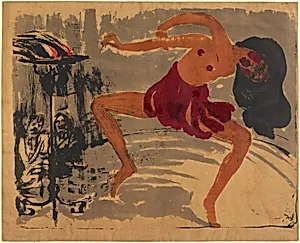
Medium
color lithograph on wove paper, proof with hand coloring
Dimensions
sheet: 70.7 × 57.3 cm (27 13/16 × 22 9/16 in.)
Classification
Department
CG-W
Museum
National Gallery of Art, Washington, D.C.
Credit
Gift of Ruth Cole Kainen
Accession Number
2012.92.147
Rights
Public Domain
Art Historical Context
Emil Nolde's *Dancer* (1913) is a vibrant color lithograph on wove paper, a proof enhanced with hand coloring that lends each impression a unique, painterly touch. Measuring 70.7 × 57.3 cm, this print exemplifies Nolde's mastery of lithography, a technique that allowed him to layer bold hues directly onto stone for vivid, expressive results. As a proof, it represents an experimental stage in printmaking, where the artist could refine colors by hand—bridging the reproducibility of prints with the intimacy of original works. A leading figure in German Expressionism and associated with the Die Brücke group, Nolde infused his art with raw emotion and intense color to capture the dynamism of modern life. Created on the eve of World War I, *Dancer* reflects the era's fascination with movement, primitivism, and the human form, themes Nolde explored through dance motifs inspired by ethnographic influences. Prints like this democratized his revolutionary style, making high art accessible beyond elite collectors. Generously gifted to the National Gallery of Art by Ruth Cole Kainen, this piece in the CG-W department invites visitors to witness Nolde's innovative fusion of tradition and fervor—a testament to how early 20th-century artists pushed printmaking into emotional abstraction.
About the Artist
Emil Nolde · 1867–1956
Emil Nolde, born Hans Emil Hansen on August 7, 1867, near the village of Nolde in what was then Prussian Schleswig (now Denmark), grew up on a farm amid devout Protestant Danish and Frisian peasant parents. The youngest of four brothers, he apprenticed as a woodcarver and illustrator in Flensburg from 1884 to 1891, working in furniture factories before studying at the School of Applied Arts in Kar...