Ctrl K
1867–1956
Emil Nolde, born Hans Emil Hansen on August 7, 1867, near the village of Nolde in what was then Prussian Schleswig (now Denmark), grew up on a farm amid devout Protestant Danish and Frisian peasant parents. The youngest of four brothers, he apprenticed as a woodcarver and illustrator in Flensburg from 1884 to 1891, working in furniture factories before studying at the School of Applied Arts in Karlsruhe in 1889. He later taught drawing at the Museum of Industrial and Applied Arts in St. Gallen, Switzerland, from 1892 to 1898. After rejection from the Munich Academy, Nolde took private lessons with painter Friedrich Fehr in 1898, studied under Adolf Hölzel at the Neu-Dachau School, and attended the Académie Julian in Paris in 1899, immersing himself in Impressionism and Post-Impressionism.
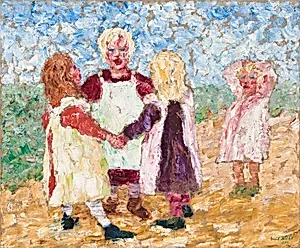
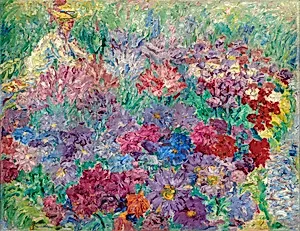
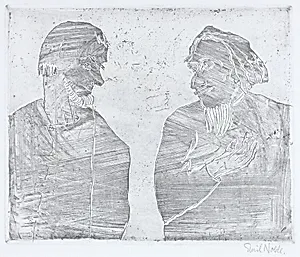
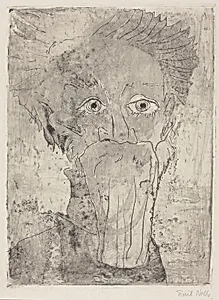
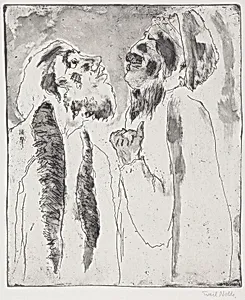
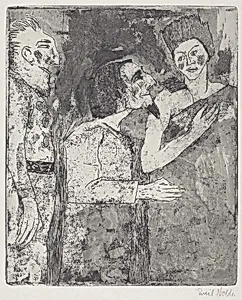
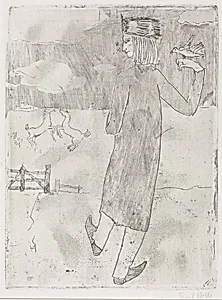
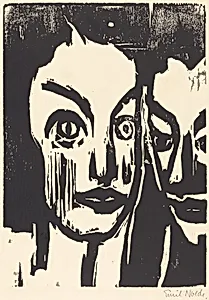
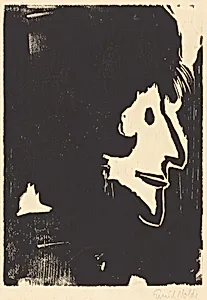
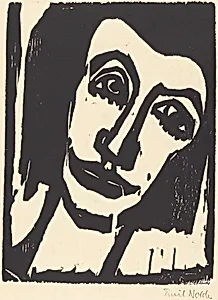
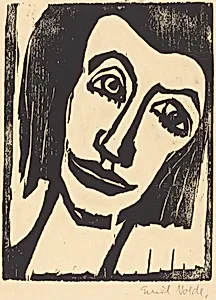
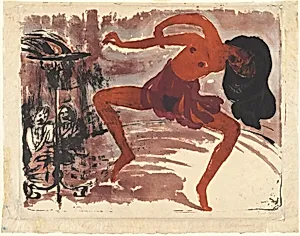
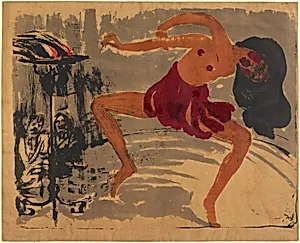
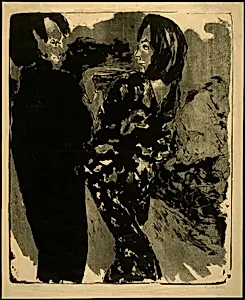
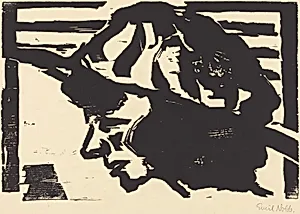
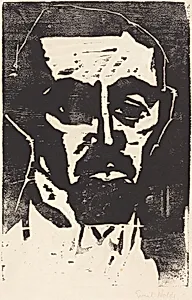
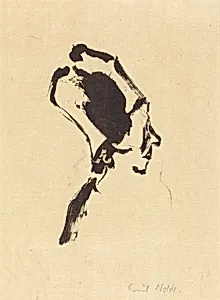
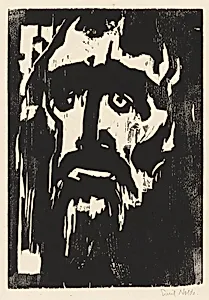
In 1902, Nolde married Danish actress Ada Vilstrup and adopted his birthplace as his surname, marking his emergence as an independent artist. A pioneer of German Expressionism, he joined the revolutionary group Die Brücke in Dresden in 1906—teaching etching and woodcuts there briefly—before parting ways in 1907; he later exhibited with the Berlin Secession (1908–1910) and Der Blaue Reiter in 1912. His style featured bold, luminous colors—vibrant yellows, deep reds—and thick, gestural brushwork, capturing emotional intensity in flowers, stormy seas, religious visions, and primitive masks. Influenced by Vincent van Gogh's florals and Paul Gauguin's primitivism, standout works include *The Last Supper* (1909), the nine-panel *Life of Christ* polyptych (1911–1912), *The Prophet* woodcut (1912), *Grosse Sonnenblumen* (1928), and vivid watercolors like *Tulips* (c. 1940).
Nolde's career darkened under the Nazis, whom he initially supported with anti-Semitic views, yet 1,052 of his works—more than any other artist—were confiscated as "degenerate art" in 1937, leading to a painting ban in 1941. Defiant, he created over 1,300 secret "Unpainted Pictures" on Japanese paper. Postwar, he was honored with Germany's Pour le Mérite, and the Nolde Foundation opened his Seebüll museum in 1957, preserving his legacy as a color revolutionary who bridged folk primitivism and modernist expression, though recent scholarship critiques his Nazi ties.